
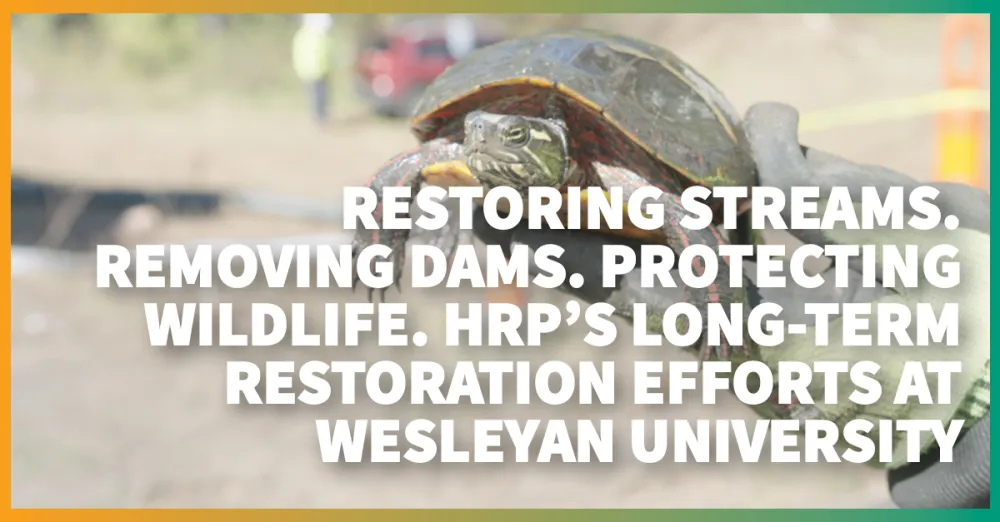
Restoring Streams, Filling Ponds, Removing Dams, and Saving Some Turtles: HRP’s Long-Term Restoration Efforts at Wesleyan University
January 5th, 2026




HRP’s mindset of finding smarter, cleaner, and more sustainable solutions for the communities we serve has guided a long-running effort at Wesleyan University's Long Lane property in Middletown, Connecticut, where HRP is leading a cleanup and ecosystem restoration that has been decades in the making.
What began as a complex site transfer in the early 2000s has evolved into a multi-phase environmental project touching nearly every corner of the 100-acre former state facility. Wesleyan purchased the Long Lane School property in 1999, inheriting a landscape shaped by more than a century of varied use, from agricultural fields to coal-fired power operations to the site of a youth detention center.
“When Wesleyan bought the property, it triggered the Connecticut Transfer Act,” explains HRP CEO Dan Titus. “Everything had to be fully investigated and remediated to CT DEEP standards. HRP was hired to push through the investigation and remediation for the entire property.”
One of the most significant challenges came from the old coal-fired boiler plant on the property that operated for nearly a century. Coal ash from the facility had been used as fill across the site, with hundreds of thousands of yards of impacted soil that needed to be removed.
By 2014, a lot of the site had been addressed, but the pesticide-impacted areas associated with historical orchards remained. Regulatory discussions, evolving standards, and the state’s fiscal challenges delayed the final phase for almost a decade before the pieces started to align again. Pesticide standards changed, funding stabilized, and everyone was able to come back to the table.
A New Approach to an Old Pond
Today, the project has entered a new phase, one that has been approved by CT DEEP and is being overseen by the U.S. Army Corps of Engineers. This phase focuses on a one-acre pond and surrounding wetlands impacted by historical pesticide use. Sediments within the pond carried traces of past runoff from nearby orchards, and in aquatic environments, the state’s standard for these compounds is essentially zero.
The site also included a low-functioning dam contaminated with historic coal ash. CT DEEP prefers to see low-class dams removed, and this one didn’t serve and real ecological or recreational purpose.
HRP’s team began exploring a solution that would not only meet regulatory goals but also restore the landscape.
“We realized that if we removed the dam and restored the original stream channel, the former pond bottom would become upland,” says Dan. “That opened the door to safely relocating pesticide-impacted soils from the old agricultural fields into the former pond footprint — an area with a different groundwater classification and less sensitivity.”
Connecticut regulations allow certain types of impacted soils to be relocated on site under strict controls. HRP used that framework to design a remedy.
Engineering Restoration with Ecology in Mind
With approvals secured in December 2024, the pond has since been drained and a wildlife relocation program began, including the safe removal and transfer of resident turtles. From there, HRP is removing the coal-ash-impacted dam and excavating the pond sediments, placing them beneath four feet of clean fill. Compatible pesticide-impacted soils from the upland agricultural fields will be relocated to the newly created upland area of the former pond. HRP will also bring back the stream channel with plunge pools, armoring, and natural stone to prevent erosion. The entire area will be landscaped and restored to blend seamlessly with its surrounding environment.
“When this is done, it’s going to look picturesque,” Dan says. “The stream will have cascades, natural stone, native plantings — and all of it will sit safely on top of contained materials.”
The project is expected to continue for several more months as soil relocation and restoration activities progress. When complete, Wesleyan will finally be able to close the book on a 20-year environmental journey — one that started with aging infrastructure and legacy contamination and is ending with a restored ecosystem.


 Login
Login


